Fresh bouquets are a week of pleasure and a bin full of regret. On the quiet longevity of dried flowers, and how to arrange them well.
There is a particular guilt that comes with a fresh bouquet: three days of glory, a week of drooping, and then the bin. Dried flowers are the alternative — less dramatic, arguably more beautiful, and still there in January, unchanged, waiting to be moved to a different vase.
What dries well
Not everything. The reliable candidates are papery or woody: statice, sea holly, strawflower, wheat, pampas, bunny tails, dried grasses, eucalyptus, hydrangea. Roses and lavender dry beautifully if picked at the right moment. Avoid fleshy flowers — they rot rather than dry.
The drying method that works
Cut on a dry morning, after the dew has gone. Strip the lower leaves, bunch in small groups — no more than ten stems — and tie loosely with twine. Hang upside down in a dark, warm, airy room. Light fades colour; humidity grows mould. Two to three weeks later, the stems snap rather than bend, and they are done.
Arranging dried flowers
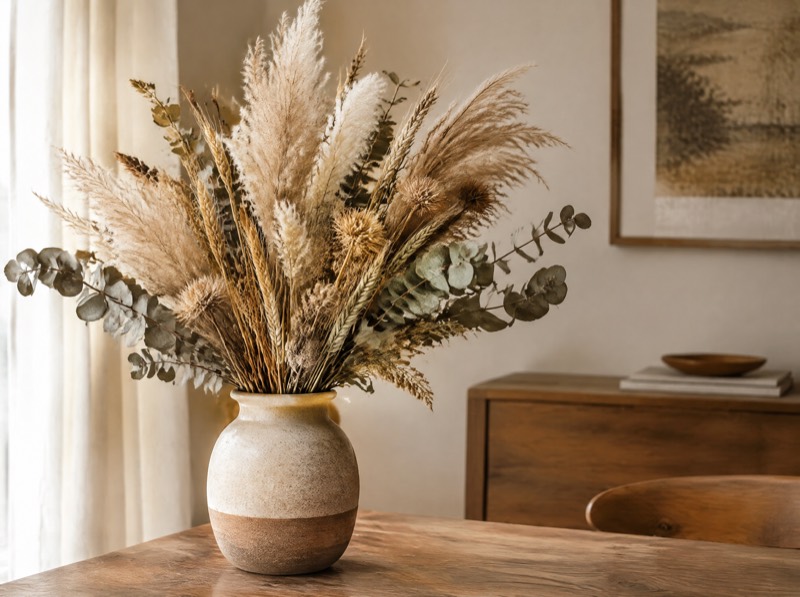
Dried flowers behave like sculpture rather than flowers. Use an odd number of stems, mix three heights, and let the material be itself — pampas soft, wheat upright, eucalyptus arching. A simple ceramic vase in a neutral tone lets the arrangement speak. Nothing needs water, which means anything can be a vase: a jar, a jug, an old bottle.
Keeping them beautiful
Keep dried arrangements out of direct sun and away from damp; a bathroom is the worst place for them. Dust gently with a hairdryer on cool — brief, from a distance. With reasonable care, an arrangement will last years. When it finally fades, compost every part of it.
The economy of keeping
A dried bouquet costs about the same as a fresh one and lasts thirty times longer. It asks nothing after it is made. It is, quietly, the most honest flower purchase: no waste, no water, no guilt — just something beautiful that stays beautiful.